

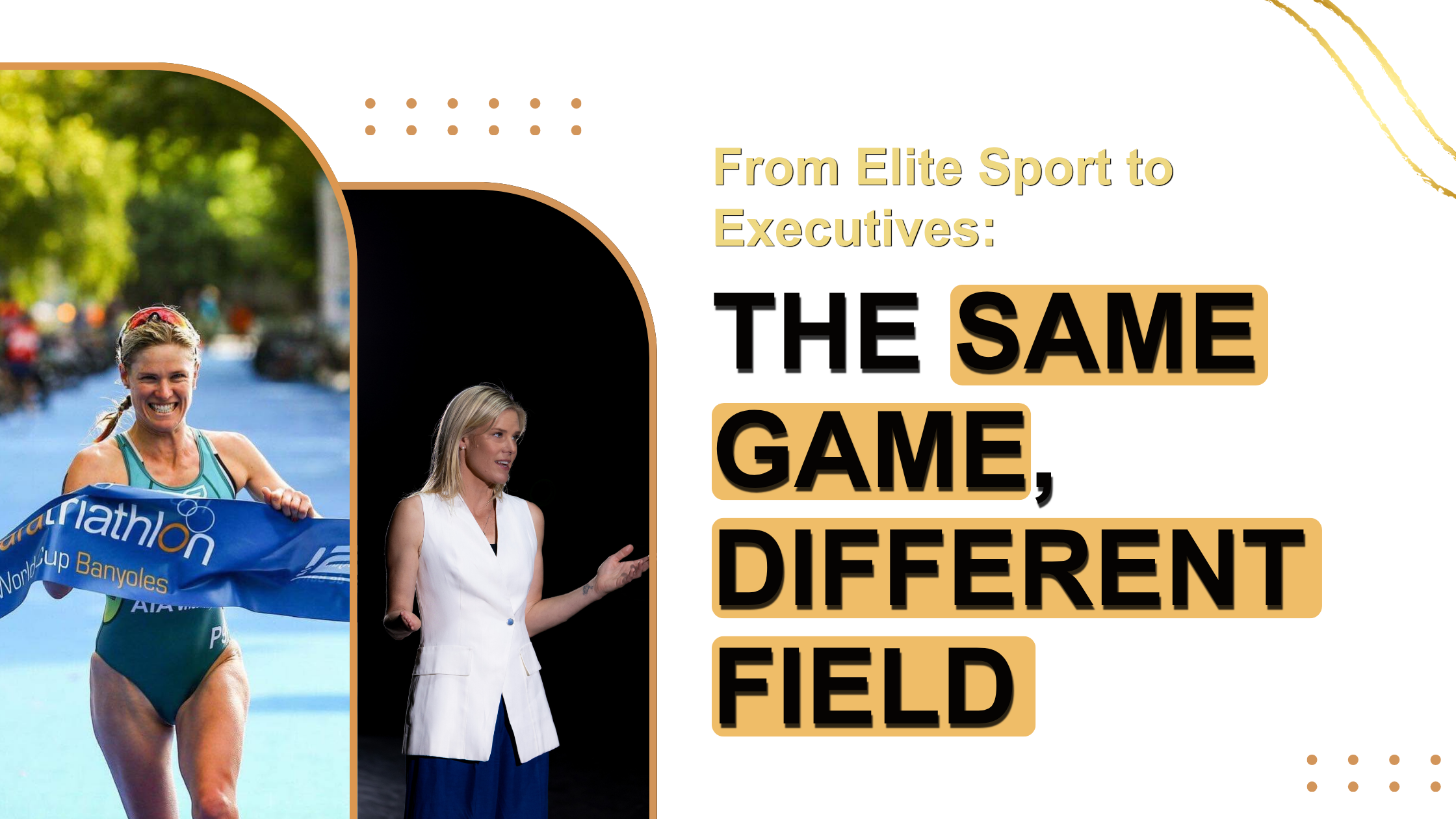
If you’ve ever wondered what happens when you take someone out of elite sport and drop them into the world of executives, the short answer is: nothing really changes.
The longer answer is what this post is about.
I spent over 20 years in high performance environments — a blend of time as an elite athlete, then working with elite athletes, and as an organisational psychologist working with leaders and teams. And what I kept finding, regardless of the context, were the same patterns. The same mindset challenges. The same performance anxiety. The same difficulty switching off. The same identity pressure — if I’m not performing, who am I? The same obsession with meeting outcomes and expectations, whether ones own or KPI’s.
The only real difference was how much attention those patterns got.
Athletes had coaches, recovery plans, structured training cycles, and someone literally monitoring their training load. Executives had calendars that looked like Tetris on expert mode — blocks everywhere, no recovery strategy, constantly in performance mode.
Same Pressure, Different Outfit
In sport, pressure is legible. There’s a scoreboard. There’s a clock. A crowd reacting in real time. If you mess up, you don’t need a performance review — you get instant feedback in the form of a score, a whistle, or a very direct coach on the sideline.
In corporate life, the scoreboard is less obvious but no less real. It’s revenue targets. Quarterly expectations. Stakeholder pressure. Team morale. Personal reputation. It’s also that one email you opened three days ago, told yourself you’d reply to later, and which has since become a low-grade source of ongoing stress.
I watch leaders carry ten different mental scoreboards simultaneously — none of them visible to anyone else, all of them marked urgent.
So what does this mean for our wellbeing?
The body doesn’t distinguish between a start line and a spreadsheet — it responds to sustained pressure the same way regardless of where that pressure comes from. When stress becomes constant rather than occasional, the body doesn’t get the chance to come back down to baseline before the next demand hits. Athletes and executives both operate in environments where high performance is expected consistently, without excuses, rather than treated as occasional or optional.
The underlying strain is similar. What differs is the response. Some people stay in constant reaction mode until something gives. Others learn to regulate, respond and reset, so they can face what’s next without the accumulated overload.
The “Always On” Myth
No serious athlete trains at full intensity every day. If they did, the body would break down within weeks. Muscles need recovery to strengthen, and the central nervous system needs downtime to consolidate that adaptation. Motivation, concentration and decision-making quality all degrade without genuine rest. Every serious high-performance program is built around structured cycles of performance and recovery — and not just physical recovery, but mental, emotional and purpose-driven recovery too, built in deliberately and with intention.
The principle isn’t complicated. The performance is where the adaptation is expressed; the recovery is where it actually happens. You get stronger during the recovery that follows the effort, not during the effort itself.
In business, we’ve somehow built the opposite assumption — back-to-back intensity, constant availability, always responsive. And when we feel like we’re crawling to the finish of the week, the month, or the year, we hope it will be different next time.
What Gets Labelled as Success
One of the clearest lessons elite sport teaches you: performance comes at a cost if you don’t intentionally manage intensity, with recovery built into the system rather than treated as optional. In corporate environments, exhaustion gets disguised as ambition, stress as commitment. Some wear these as a badge of honour, without realising what it’s actually costing them.
Think of it like a laptop battery. If you never close the tabs, never plug it in, and just run it continuously on whatever charge is left, it rarely fails dramatically. It degrades quietly instead. Slower to start. Slower to process. Less reliable under load. Until one day it stops holding charge at all, and it feels sudden, even though the warning signs were there the whole time.
That’s a fair picture of what running without recovery looks like in a person. The decline is gradual, easy to ignore, right up until it isn’t.
What 20 Years in High Performance Actually Taught Me
Sport strips performance down to what it actually is. There’s no fluff to hide behind, no overcomplication.
The fundamentals were straightforward: train smart, recover intentionally, focus on what matters, execute under pressure, and learn fast enough to adjust faster. Just as important was accepting feedback quickly and without ego, because in sport the feedback arrives whether you want it or not. You know within seconds whether something worked. There’s no ambiguity.
Leadership doesn’t offer that same clarity. The feedback loops are longer and less obvious. You can carry a flawed approach for a year before the real consequence shows up, which is part of why I’ve found sport principles so useful in my work with leaders — they shorten the learning cycle, make patterns visible earlier, and stop people mistaking exhaustion for progress.
The executive running on four hours of sleep and back-to-back commitments, calling it dedication, is performing at a declining level while telling themselves a story about what that means, rather than performing at a genuinely high one. I know what that looks like because I’ve been that person, and I’ve seen it often enough in the leaders I work with to know it’s common — and entirely fixable.
The HYPE Program
My work with executives is built around HYPE — Heighten Your Performance Excellence.
The name matters less than what it means in practice. It’s about staying in performance for long enough that you don’t collapse halfway through — building the systems that actually support the standard you want to maintain, rather than grinding against a rhythm that’s working against you. It was never about performing at your peak for one quarter, or even one good year.
HYPE is about building self awareness of your mind and body, and your default operating rhythm. The goal is sustainable performance, without compromising your health, your relationships, or your long-term effectiveness.
The Actual Point
The nervous system I had as an athlete overthinking a race start is the same nervous system I have leading into a high-stakes client presentation. Different arena. Same human.
The pressure is comparable. The psychology is comparable. The performance demands are comparable.
What differs is the self awarenss I have developed, alowwing me to ntentionally respond to the pressure rather than react in a state of panic, overthinking, feeling tense and losing focus, and simply pushing through, feeling exhasuted.
High performance is about performing with intention, recovering properly, within the moment and between, and building a way of working you can sustain not just for this quarter, but across the length of a career worth having — not simply about pushing harder.
If you’re an executive who wants to perform at a genuinely high level without sacrificing your health along the way, that’s exactly what HYPE is built for.
Subscribe to the HYPE Newsletter for practical insights on managing your energy, directing your focus, and leading under pressure — straight to your inbox, no pitch attached.
Leave a Reply